Your playbook for de-risking product launches 🔭
GET THE GUIDEThe psychology behind ads that make people buy

Human psychology is at the center of every great ad.
Whether it’s their ability to cultivate prospective-shifting emotions frame-by-frame or the way they use perfectly placed social proof to propel consumers towards a purchase, great ads know how to influence consumers’ perceptions, emotions and behavior.
In this post, I cover the psychology behind effective advertising, showing you the psychological mechanisms behind ads that work.
You can’t have effective advertising without understanding buying behavior. Understanding which psychological levers need to be pulled to move prospects from “never heard of you” to “can’t not buy from you” is the essential starting point for creative effectiveness.
Whether your target audience is seeking variety, buying out of habit or looking to emulate friends or celebs — you need to understand why people buy and what they need from your creative to act on the seemingly “random” instinct they get to make a purchase when they see your product online or in-store. As I’ll show you below, that seemingly random instinct is not so random when you build your ads around the right psychological drivers.
Advertising as a psychological and behavioral driver
"Until you make the unconscious conscious, it will direct your life and you will call it fate."
- Carl Jung
Effective advertising directly influences our unconscious, the deeper level of our psyches that exist outside of conscious awareness.
The unconscious holds our deeper emotions, guiding beliefs and memories. It directly shapes our surface thoughts, feelings and behaviors.
The unconscious might explain why people pick frustrating romantic partners, with similar flaws to their parents, even though they know intellectually they aren’t a good fit. It may explain why certain places feel like “home” – even when we’ve never been there before. And it may explain why we automatically grab a pint of Cherry Garcia from the freezer after a stressful day, seemingly on autopilot. Often the things we do that seem to be connected to instinct or even thoughtlessness rather than intentional thought or action can be explained by the unconscious.
In his best-selling book Thinking Fast and Slow, Daniel Kahneman explores how System 1 thinking, which may be interpreted as another term for Jung and other psychoanalytic theorists' concept of the unconscious mind, is the core driver of our behavior.
Kahneman's System 1 thinking, also known as “fast thinking”, is the automatic, intuitive mode of thought that influences the majority of our decision making. This mode of thought is built on emotions, intuition and heuristics, rather than in-depth rational and analytical processing.
Advertising acts as a core psychological and behavioral driver. Great ads have the ability to shape and heavily influence people’s perceptions, emotions, values and choices. Ads influence the unconscious with a combination of music, visual elements, story, emotion, branding and more. This is a process known as conditioning, or learning through association, which can automatically start to cue the brand or product in consumers’ minds.
From exposure to decision: the path advertising travels
An initial exposure to a commercial typically resonates in our unconscious mind, whether it’s the humor of the ad, the resonance of a tagline or the mirroring of a relationship in our own lives between two characters — resonant elements plant a seed in the unconscious mind.
The next time we see the product featured in the ad in store or see a social media post from the same brand, our connection to them deepens, building on the initial impact. Each of these exposures builds on the last, impacting brand appeal, sentiment and consideration — nudging us towards a purchase.

Maslow's Hierarchy of Needs highlights the essential human needs that underpin the human experience.
Nearly all directly target one or more of consumers’ foundational emotional, social or practical needs.
Take nostalgia-based ad content that targets consumers’ needs for belonging and identity. While ads that explore human creativity, social values and self-transformation connect to consumers’ need for self-actualization.
Emotional appeal over rational messaging
Affective Response Theory holds that emotion-driven information has a bigger impact on memory, behavior and cognitive processing than neutral or purely rational information.
Purely emotional ad campaigns deliver a 31% jump in profitability compared to 16% for ad campaigns with a rational focus. Ads that tap into emotions like joy, fear, nostalgia or belonging create deeper connections and stronger memory encoding than purely informational messages.
Emotional advertising understands that emotional drivers are often more powerful for human beings than rational ones. It's our emotions that dictate much of our purchasing decisions, not a balanced analysis of pros and cons.
Advertisers can heavily influence consumers' purchasing behavior by tapping into what Kahneman calls System 1 thinking through emotional elements — whether that’s witty taglines, relatable characters or emotion-driven narratives. Colin Pye says:
"When it comes to making purchasing decisions that are not crucial or life-changing, such as choosing a type of a detergent or even a type of a car, those decisions will be made by System 1, which will match an intensity of emotion towards a certain brand with a willingness to buy. Sometimes System 1 will ask System 2 for a rational verification (like in the case of a car), but rational analysis will not commence without an emotional response being there in the first place."
Emotional advertising understands that emotional drivers are often more powerful for human beings than rational ones. Ultimately, it's our emotions that dictate the majority of our purchasing decisions, not a calm analysis of benefits, brand values or even price.
The role of visual and narrative storytelling
Visual design, color psychology and storytelling are also some of the most essential elements that influence and shape consumers’ perspectives and behavior.
Humans are wired for story. Storytelling releases dopamine in the brain. We become attached to characters — their decisions, their plot, their emotions.
Storytelling also sparks the process of neural coupling, when we become immersed in a narrative our brains perfectly sync up with each arc in the story. If an ad shows a character placing a freshly-baked loaf on the stove, our olfactory regions (those that process scent) in our brains light up.
Stories also deliver social cohesion — as the listener, we feel a deeper sense of belonging and connection with both the storyteller and the people within the plot.
You can tap into consumers’ natural affinity for stories with narrative-driven plots.
Stories are the perfect vehicle for impacting consumers’ unconscious emotions, desires and behaviors. Nostalgia-rich stories help consumers feel affinity and appreciation for both your ads and your brand. High-octane stories create excitement — improving brand affinity and brand recall.
Visual elements and color also have a large influence on emotion and perception. 90% of the information we notice and process is visual. Dynamic scenes, surprising visual elements and distinctive color choices can quickly capture consumer attention and draw them into a narrative — deepening their connection to a product and brand.

Here are how some of the most popular colors in advertising impact consumer emotions and perceptions:
Red: Red delivers a sense of passion, excitement, energy and love or sexuality.
Blue: 43% of Fortune 500 companies have blue in their logo. Blue is connected to calm, tranquility, professionalism, trust and loyalty.
Yellow: Yellow is connected to fun, joy, and optimism. Like a softer yet lighter red, yellow grabs attention, stirs high-affect emotions and motivates action.
Purple: Purple is the color of luxury. Consumers often unconsciously relate it to sophistication, royalty and indulgence.
Pink: Pink unconsciously symbolizes romance, warmth, comfort, calm and compassion.
There are several cognitive mechanisms of influence that drive brand and product awareness, sentiment, loyalty and memorability. Here are the main ones.
Exposure and familiarity
The exposure effect dictates that repeated ad exposure increases recognition and preference through familiarity.
The more we see something, the more we like and trust it. The familiar is safe, comfortable and likable. While the unfamiliar often feels like a threat and triggers anxiety.
Even things that are nonsensical can become more likeable through repeated exposure. Robert Zajonc (1968) ran a series of experiments involving nonsense words. The more test subjects were exposed to the words, the more they liked them. Following Zajonc's study, researchers replicated the effect in over 200 studies.
As with nonsense words, people tend to like an ad, brand or product the more they’re exposed to them. Repeat exposures begin to work ads, brands and products into consumers’ unconscious minds, making them more likely to buy the product.
Persuasion principles and cognitive shortcuts
Persuasion principles work under the surface, influencing our perceptions, behavior and emotional states outside of our conscious awareness. You can layer several persuasive techniques into your ads to influence consumer decisions.
Social proof is one of the most effective persuasion techniques. From our use of slang to fashion trends, we’re heavily influenced by the people around us. When it comes to purchasing decisions, consumers often see products or services that other people rate highly as worthy of their investment.
Examples of effective social proof include positive customer testimonials, user generated content (UGC), and reviews. 92% of consumers say they hesitate to buy a product if there are no customer reviews. UGC shows a conversion lift of up to 270%.
Authority acts in a similar way to social proof, only instead of being motivated by the positive opinion of other consumers, consumers are influenced by endorsements from professional bodies, recognizable organizations and experts like psychologists or doctors.
Scarcity is another powerful persuasion tactic. We value things more when we think they are rare or limited. “Limited-time offers,” “sale ends in 24 hours,” “running low on stock.” These all trigger consumers’ anxiety and fear of missing out, driving them to buy. Researchers found that scarcity can increase conversions by up to 332%.
Liking is another powerful principle of persuasion. We’re more likely to give our business to people and brands who we like.
"People prefer to say yes to those that they like. But what causes one person to like another? Persuasion science tells us that there are three important factors. We like people who are similar to us, we like people who pay us compliments, and we like people who cooperate with us towards mutual goals."
- Influence At Work
Think: strong founder-led brands, brands with strong social values that mirror their customers’ and brands with witty, memorable marketing campaigns. Research finds that likable brands are authentic, sincere and relatable. While ads with characters who embody these traits more effectively connect with consumers and persuade them to buy.
Elevating the role of research with behavioral science
Catch behavioral scientist Richard Shotton and Zappi's Chief Customer Officer Julio Franco for a great session on how applying key behavioral psychology principles to market research can help you elevate insights.
46% of our daily actions are triggered by habits. Let’s take a look at how advertising can successfully support habit formation and support brand loyalty.
Reinforcing behavior over time
Many of the biggest brands use ad campaigns to create habit loops:
Cue: A specific trigger. You see your toothbrush on the side of your sink in the evening.
Routine: You unconsciously associate the sight of your toothbrush with brushing your teeth.
Reward: You get that minty-fresh clean mouth feeling. Side note: manufacturers actually added mint to toothpaste because consumers struggled to maintain their toothbrushing habits, creating the "reward" in the toothbrushing habit loop.
Many brands build habit loops to successfully motivate seasonal sales by creating a seasonal trigger. Take Starbucks' Red Cup Day.
Every year, the launch of the Red Cup acts as the "cue" that the holiday season has started. On Red Cup Day, consumers can order a Starbucks’ holiday special — from gingerbread lattes to peppermint hot chocolates. In exchange, they get a free reusable, festive red cup.

2025's cup featured a hand-drawn illustration of a Starbucks storefront by designer Yvonne Chan. “The design is inspired by the little moment of magic you feel when you step into a Starbucks from the cold outside,” Chan said. “With the hand-drawn sketch, I tried to capture the feeling of something crafted by one person for another.”
By creating a deeper feeling of connection and excitement with the holiday season, Starbucks helps spark the immediate association with Starbucks’ beverages and holiday cheer as soon as consumers see the brand's iconic red cups.
Brand trust and repeat purchase loops
When done well, brand-triggered habit loops build deeper trust and brand loyalty by supporting enjoyable rituals.
Starbucks helps deepen the excitement and fun of the festive season on Red Cup Day. After buying their first red cup — they get a dopamine kick: enjoying the design, the taste and sharing in a moment of connection with other consumers (cue Red Cup Day hashtags across social media).
This deepening of trust and the creation of core seasonal memories creates repeat purchase loops — making consumers more likely to return for another red cup next December.
Here’s how to build ads that go beyond making great impressions and influence action.
Design ads for the right cognitive and emotional targets
As human beings mainly make decisions off of deeper unconscious emotions or System 1 thinking, ads with emotional elements typically perform best.
To increase sales, you need to make sure your ads hit the right emotional pain points and propellants — elements that intrigue, interest and excite consumers. To uncover what these are for your target audience, you need to talk to your prospective prospects and customers directly to find out which emotional elements are most powerful for them — whether that’s nostalgia and connection or excitement and adventure.
Zappi’s Amplify Advertising System helps brands to track and understand consumers’ emotional responses to your ad and improve their effectiveness when it comes to influencing consumers’ emotions and decisions.

Amplify tracks second-by-second emotional engagement, measuring emotions like sadness, laughter, love and anger — allowing you to understand which moments emotionally resonate with your audience. Amplify helps brands gather insights early and often, allowing them to use what they find to refine creative and improve its ability to emotionally connect with consumers on a consumer insights platform that is up to 60% more predictive than other ad research approaches.
"What if you could make those great ads even greater over time? What if you could discover the key elements that made your ad great, so you can do it again and again? Or improve it even further for your next campaign? Zappi is the only agile market research platform that creates a learning loop that allows you to do just that, making you smarter the more you use it." - Kim Malcolm
While emotional elements, such as emotional-driven storytelling and strong visuals, are the key persuasive components of your ad, you can pair this with rational data within your wider campaign.
While emotion-based ad elements that influence the unconscious mind do the majority of the cognitive work that nudges consumers towards making a purchasing decision, the consumers might also be looking for rational data to back up their emotion-driven desires to purchase as they move closer to the conversion.
Objective, rational data like expert endorsements, performance stats, certificates and awards all reduce risk and dial down the anxiety that’s inherent to every purchasing decision.
Use repetition and multi-channel exposure to build familiarity
If you want to create sales and strengthen customer loyalty, repetition is essential. Whether consumers buy from you on their fifth exposure or their 20th, delivering consistent messages across channels is important for building a sense of familiarity and the trust that’s essential for moving consumers towards a purchase.
Draw consumers into a deeper relationship with your brand by using the echo effect to repurpose elements of your campaign across channels. Share inside ad jokes on your OOTH billboards to trigger consumer curiosity. Explain the joke and deepen the story in your on-air commercials. Make your short-form TikTok and Instagram videos feel like “the next chapter” of your TV commercial.
Embed social cues and persuasive triggers where relevant
Social cues and the ethical use of persuasive triggers like social proof, urgency and authority can accelerate purchase decisions.
As with building effective emotion-driven ad campaigns, it’s important to build your campaigns on research-backed insights into the persuasive triggers and social cues that’ll be most effective with your audience. Pair consumer research with ad testing to uncover which approaches show the potential to drive the most conversions for your consumer.
For example, customer interviews may uncover that your target customers are most likely to be influenced by recommendations from qualified professionals (that’s our authority component/motivator). While past campaigns have shown that customer testimonials have been essential for driving more purchases (social proof). Use Zappi to test out different ad variations featuring either authoritative endorsements or social proof and get real-time consumer feedback on which ads are most persuasive.
Measure not just clicks, but psychological lift
Clicks give a one-dimensional view of your brand and creativity. It’s important to measure psychological lift and make sure you can access the data you need to understand whether your marketing is having a deeper influence on consumers’ perceptions, sentiment and behaviors.
Zappi goes beyond simplified metrics, helping you understand the why behind your clicks, conversions and sales.
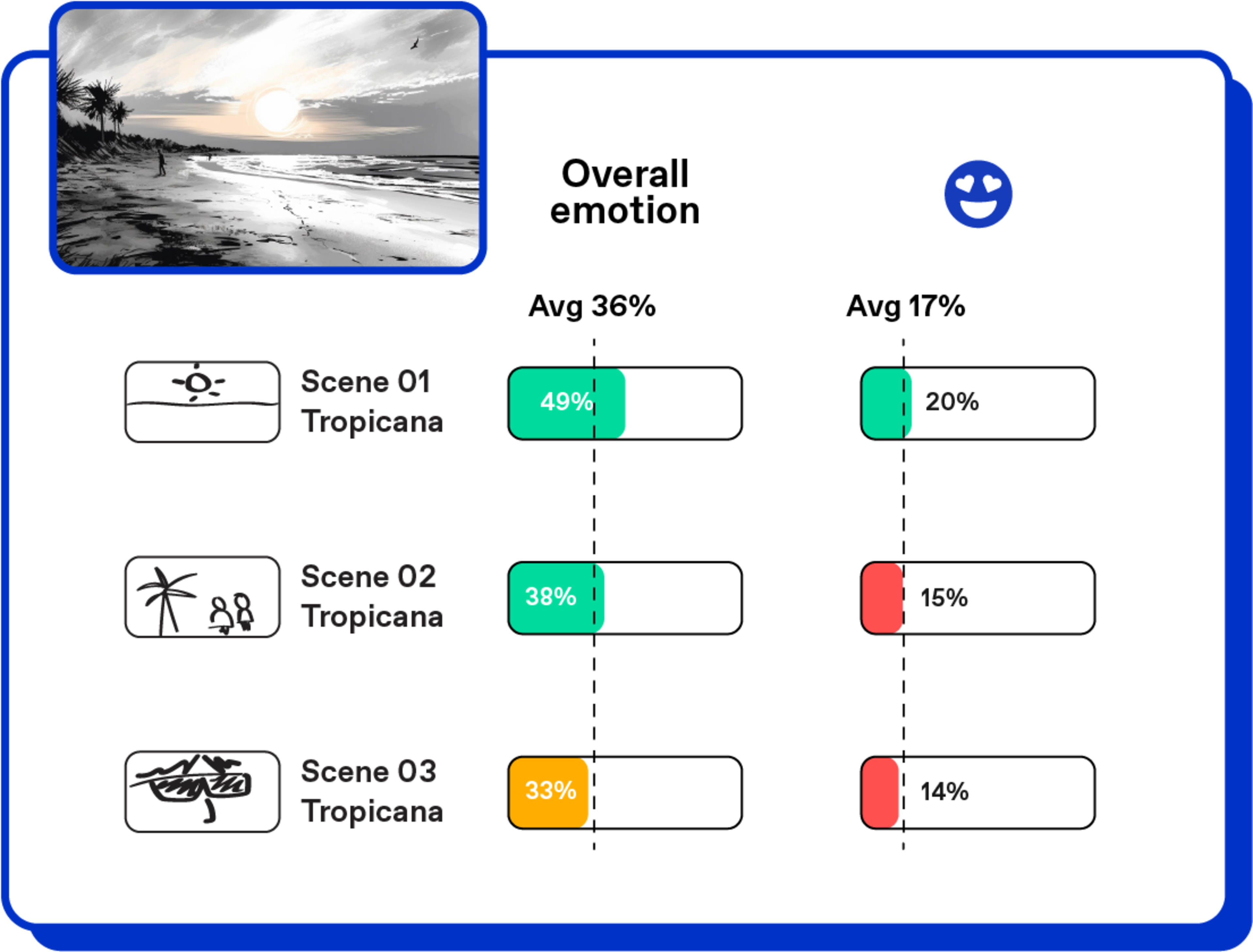
As I cover above, you can use Zappi’s Amplify to measure the emotional resonance of your ads, track moment-to-moment emotional reactions and compare the emotional impact of different scenes in your ad.
You can also use Zappi to test brand recall by showing an ad in context to mimic real-world engagement and asking consumers to identify which brand the ad is for, which is analyzed to provide a brand recall score for your ad.This score (as well as other insights) is summarized in our AI Quick Reports and benchmarked against a database of ads that share your category.
What’s more, to keep an eye on the overall pulse of your brand, Zappi’s Brand Health Tracker gives you real-time insights into how consumers see, experience and respond to your brand in-market. This measures awareness, consideration, usage and appeal, exploring how your brand connects to the category entry points that shape brand choice. You can track and compare how your brand performs across categories and markets, comparing it to up to 15 different brands.
Find out more about how Zappi can help you build psychologically-persuasive ads here.
State of Creative Effectiveness report
Want more content on how to create better ads? Download our latest State of Creative Effectiveness report.


But ads don’t exist in a vacuum. Let’s look at the layers of social and contextual influences that impact consumer perceptions and drive purchase decisions.
Social proof and influencer endorsements
As Social Sprout says, people trust people more than they trust brands.
Only 50% of consumers say they trust the brands they do business with. While only 28% of Gen Z consumers say they feel they can trust most brands.
If consumers don’t believe brands then who do they believe? Other consumers. As I cover above, social proof is one of the most effective ways to influence consumers’ perceptions and purchasing decisions — with the ability to increase your conversions three fold. Social proof:
Reduces anxiety and uncertainty: When consumers feel uncertain about what to do, they look to the wisdom of the crowd. Popularity signals value. 5-star reviews and rave testimonials give consumers confidence in a potential buying decision.
Acts as a cognitive shortcut: Social proof speeds up cognitive processing, consumers spend less time researching and weighing up options when they see that a product or service has been pre-approved and endorsed by other people.
Validates their decisions: When a product is endorsed by someone consumers admire they feel validated in their decision. Parasocial relationships with celebs and influencers, in which consumers feel like they know and have a relationship or friendship with a famous person, are key drivers of purchasing decisions. This is notably the case among Gen Z, 87% of younger consumers stating they trust brands more who use influencers.
Cultural and situational context
Cultural relevance is essential for relatability. Culturally-resonant campaigns help consumers connect to a brand through shared cultural values, norms and celebrations.
This relatability speeds up decision making by deepening consumers’ connection with a brand and creating a deeper sense of unconscious ownership with a product.
According to WARC, brands with high cultural relevance grow around 6x more than brands with low levels of cultural relevance. While campaigns that resonate culturally are 2.6x more likely to deliver long-term brand growth.
Top ad agencies emphasize the importance of going beyond basic demographics and shallow participation in cultural meaning — highlighting the need for brands to show a genuine understanding of what their cultural values, norms and celebrations mean to them and bring deeper than surface value to their experience of them.
Cairo Kenan Marsh, founder and partner of relativ* says: “If you are an international brand with roots that clearly comes from outside the market and culture in which you are engaging, it is essential to demonstrate recognition and respect for cultural values and norms, but not to pander or be assumptive about the role your brand can play in culture."
He adds:
“Cultural value comes from identifying what a brand can genuinely offer to meet consumer's cultural and social needs. How does the consumer think of themselves, how do they fit with their community and how do they want to be perceived? An impactful connection opportunity lies at the intersection of customer interests and brand offering.”
Global & Local: Balance of power or powerful everywhere?
For more on this, check out our webinar with Nataly Kelly, author of the book "Take Your Company Global," who shares practical steps on how to align your teams across borders and the benefits that can come from it.