Your playbook for de-risking product launches 🔭
GET THE GUIDEWhy advertising postmortems make your next campaign better

Reviewing an advertising campaign when it closes can be nerve-wracking, but when backed with consumer insight from the start, careful planning and excellent leadership, a postmortem analysis is a great opportunity to learn from and build on successive wins, making your ads better over time.
The key steps to building a retrospective ad campaign framework that leads to success, while avoiding common pitfalls, requires team effort, but the results are well worth the work.
Let’s dive in.
Holiday campaign reflection worksheet
Get started with our post-holiday campaign reflection worksheet, an easy guide that helps you turn last season’s insights into this year’s success.
For most creative-types, the brainstorming and design phases of a campaign can be fun, but the review at the end— whether you call it a retrospective, analysis, review or a postmortem can be tedious. But taking a look at what went well and what didn’t offers three big benefits. It gives teams the opportunity to:
Define the return on investment of the campaign
Document the elements that were most successful for future reference
Build a culture of continuous improvement
Plus, with a little bit of structure and planning postmortem, reviews can become fun and help generate ideas for future campaigns.
Let’s dive into these three benefits further.
Campaigns are investments, not experiments with no return
The world of marketing has been turbulent for the past few years. The pandemic changed everything, followed by wild supply chain upsets, a big election in the United States, the introduction and implementation of new tools associated with AI, all combined with an uncertain economy, consumer hesitation and, for many organizations, budget cuts. Getting more done with less has been the overarching theme for lots of teams for half a decade.
This set of circumstances means that virtually all marketing spend must be justified. And that’s what most expect today. Experimentation for the sake of finding out what might happen is simply not on the table for most marketing teams, and that means campaigns are viewed as investments that will deliver some form of return.
A thorough postmortem analysis clearly delineates and highlights the return on investment from a campaign. When a marketing campaign goes well, showing (and learning from) how and why creates a playbook for the future, but when a campaign goes poorly, the postmortem is arguably more important because it provides the opportunity to learn and for the lesson to be applied to future campaigns.
Memory fades fast—details are lost without documentation
Memory is tricky. Human brains are both marvels of memory and liars. Our brains have evolved to fill-in-the-blanks, which means we can unconsciously make things up in order to connect the dots when we need to. This happens so smoothly, we’re not even aware of it. It even has a name: perceptual completion.
According to research from Nature Reviews Psychology: “As time passes, the memories of one’s best and worst experiences change as content is forgotten or sometimes added to the original memory.”
If we can’t trust our memories of big, impactful events, no matter how clearly you recall all the smallest details, how can you trust it when it comes to a carefully planned advertising campaign?
The best way to avoid making the same mistakes over and over is to document your findings so you can apply them to future campaigns. Does your consumer prefer humor over nostalgia? Do they resonate with celebrities or influencers more? Tracking and documenting what your audience connects with will make it much easier to look back on past campaigns and inform the ones that will succeed in the future. That’s the purpose of a postmortem framework.
Continuous improvement beats “one-off wins”
Winning feels good, whether it’s a neighborhood pickup basketball game or a successful advertising campaign. Too often, a win is just accepted. It feels good, objectives achieved, move on.
Building retrospective reviews into your process and culture creates an opportunity to make each campaign part of an on-going improvement loop. Like I touched upon above, documentation is a huge part of this, and makes this continuous learning process all the more easy.
Regardless of individual metrics, success, failure or so-so performance, each campaign contributes to the steady progress of your team’s marketing efforts and your organization’s success. By adding an iterative learning review to the end of each campaign, tracking what worked well and what didn’t, and all the elements in between, you’ll create a continuous learning loop that allows your campaigns to get better over time.
Now that we’ve covered the benefits, let’s get into the steps to get started.
Simply deciding, or even declaring, that you’re going to institute postmortem analysis into your marketing program isn’t enough. By building a system for retrospectives intentionally, your team won’t dread the process and it’ll be much more effective, providing a clear path to continued improvement.
Here’s six simple steps to help you get started:
Step 1: Plan the postmortem before the campaign begins
As strange as it may seem, it’s best to plan your postmortem before your campaign even begins. By planning what you’re going to review and making the review part of the process of running a campaign, you avoid making it an afterthought. Plus, it helps set the stage for the rest of the steps.
Step 2: Gather all relevant data and documentation
When you know what you’re going to evaluate at the end of the campaign, you know what data you’re going to need. It’s far easier to gather the numbers and documentation as the campaign proceeds (Think: Pretesting data from consumers, launch day results, etc) than it is to scramble and try to patch it together at the end.
It’s similar to doing the dishes as you go while you cook. At the end, depending on your approach, you’ll either have a few things to clean up or you’re facing a huge mess that requires almost as much effort as cooking the meal.
Step 3: Facilitate a constructive, blameless discussion
One of the reasons many marketing teams avoid analyzing a campaign in retrospect is that it can easily devolve into a blame game. By getting a plan for the discussion in place, you can proactively facilitate a constructive discussion that contributes to improvement rather than finger-pointing.
Here are a few tips for facilitating a constructive postmortem meeting:
Have a guide who leads the discussion, who understands their role is to encourage conversation and participation
Create guidelines and a structure so that the meeting moves along smoothly and touches on all of the predetermined points
Use a general outline that includes the plan created prior to the campaign and the data and documentation gathered throughout it
Step 4: Synthesize findings into actionable insights and recommendations
A postmortem is far less productive if it doesn’t serve as a catalyst for action. Using the findings of a retrospective analysis to develop insights and make actionable recommendations for the future is the critical link to improve from campaign to campaign.
In panning for gold, the ‘49ers filtered through the rocks to find the valuable nuggets. But to find the gems in the postmortem, you have to compile and synthesize the metrics, data, documentation, context and discussion. The result builds the continuous improvement loop that you can use to inform your future campaigns.
Step 5: Document and share learnings broadly
Once you have documented your learnings, the next step is to share it widely. The inclination to hold information and silo activities appears to be one humans share across departments, organizations, industries and sectors. Resist that inclination and share your postmortem learnings to benefit the entire organization, even if the campaign wasn’t as successful as you might have hoped.
Step 6: Build into a continuous learning feedback loop
Taking this entire process and turning it into a template for each new initiative, project or campaign builds on an upward spiral of improvement. Mistakes or missteps contribute to the on-going betterment of the program, and successes and wins reveal what worked and why so it can be repeated.
Change is inevitable, but with the right data and insights, your team is more prepared for new developments. A continuous learning approach to postmortem reviews can offer more than a view to the past—it can also give you a good idea of the shape of emerging trends.

The most common pitfalls to a positive postmortem review are apparent in the steps you take to develop an effective retrospective for each campaign. For instance, planning the postmortem before the campaign sets the expectation and can prevent the postmortem from feeling negative and uncomfortable.
Here are a few other common pitfalls to avoid:
Skipping the postmortem because the campaign “did fine”
A retrospective is just as valuable for a successful campaign as it is for one that falls short. In fact, documenting what works well is perhaps even more important.
By creating a culture where there’s a postmortem for every project, all insights are collected and contribute to the continued improvement of the marketing program and future campaigns.
Bias and defensiveness derail honest analysis
When it comes to looking at what could have gone better in a campaign with your creative work, it can feel nearly impossible to be objective, since biases are part of human nature.
Bias can lead naturally to defensiveness. It’s tempting to defend your work. A retrospective review that builds a continuous improvement loop is about learning, and honest analysis must be part of the process.
Admitting to bias and accepting criticism of creative work requires a deeply embedded culture of trust, which takes time to build. The time and effort spent establishing trust is essential for lots of reasons, and is crucial for an effective postmortem framework.
Data gaps or missing context
If you haven’t properly documented insights and data along the way, you may be missing critical information when it comes time to do the postmortem.
By making a retrospective performance review part of every campaign and documenting what the postmortem will cover before the campaign begins, you can avoid the pitfall of data gaps and missing context.
Failure to follow through on action items
If you picture the process of continuous improvement as a spiral staircase, with each step representing one part of the process, you can see how dangerous leaving steps out can be. Identifying insights and making recommendations is a step, but following through on them is a different step entirely.
Without follow-through, your team doesn’t get the full benefit of all the work involved in building a postmortem framework.
Treating postmortem as one off exercises rather than systemic practice
When every project and campaign has a retrospective review, it’s an expected part of the process. That makes it easier to build a framework and eliminates the impression that the postmortem is only happening because the campaign was faulty.
Many of the common pitfalls associated with retrospectives have to do with organizational culture. When a postmortem is part of the process of every project, it promotes learning, improvement and trust as cultural elements.
After all, the purpose of conducting a postmortem is to learn from your campaign, but those learnings can’t do much if they’re kept in silos.
Adding a new element to the process of running a marketing campaign might feel like heaping work on an already-overloaded team. Happily, modern tools make gathering the data and interpreting it simpler and faster than it has ever been.
Dashboard and analytics platforms for unified data collection
Identifying what to measure before launching a campaign and collecting the data as the campaign proceeds means your team won’t need to do anything extra to prepare for the postmortem discussion. The information is there already.

Sometimes the data collection feels like you’re trying to take a sip from the proverbial firehose, with too much coming at you. Connected consumer insights platforms like Zappi help take you from ideation to optimization and data collection to clear insights reports with a click.
Zappi’s platform allows you to speed up every step of your creative development, keeping the consumer in the loop and allowing you to learn as you go. Tools like these make it much easier to not only learn from your insights, but easily refer back to what worked and what didn’t.
Shared documentation and collaboration tools
Marketing is a team sport, so shared documentation and collaboration tools are essential, both for collecting data and analyzing it during the postmortem meeting.
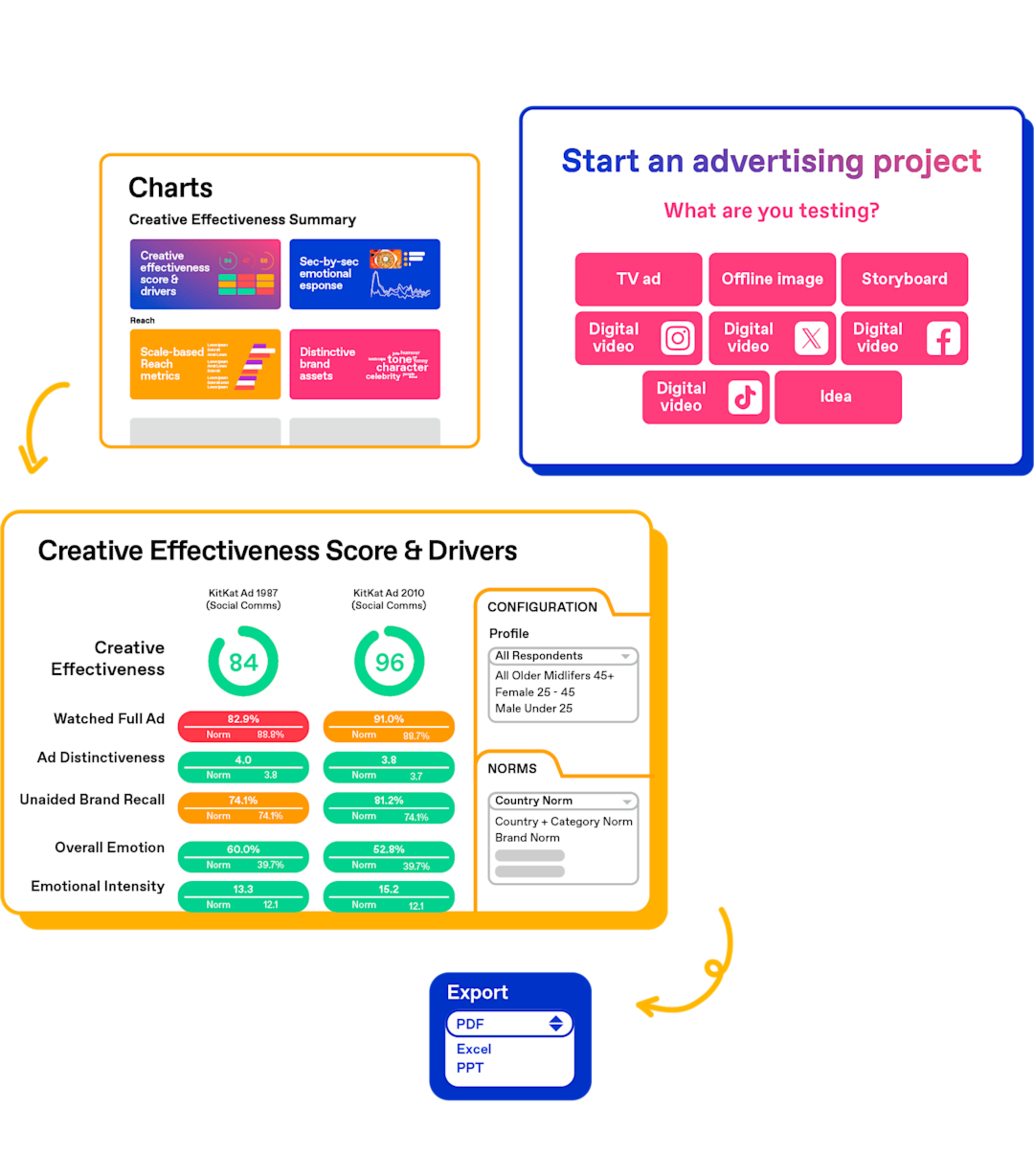
Each person on your team brings unique expertise and even when everyone has access to the same data, their interpretation of what it means is likely to vary—and each unique take offers value. Democratizing and connecting your insights through shared documentation and collaboration tools help bring all of those varying interpretations together to create useful insights and recommendations.
Automated tagging and attribution to track channels, creatives, cohorts
Some of the work of analyzing a marketing campaign can feel just plain boring. Sifting through page after page of data, tracking and comparing results on different channels, comparing the performance of creative elements, searching for differences among cohorts and similar activities are tedious (which creates an environment ripe for error) and time-consuming.
Advanced technology and modern tools like Zappi’s connected insights platform offer automated tagging and attribution, as well as AI summaries, so all the tedious work can be done automatically and accurately, allowing your team to focus on the high-level interpretation of the data and make better decisions.
It’s always a good idea to do a retrospective after every campaign. But here are some key moments to keep top-of-mind when planning when the actual portmortem should occur:
After every major campaign, regardless of size or outcome: Even though postmortems are valuable for every campaign, this is especially true for major campaigns, which likely required a bigger budget.
Quarterly and annual cross-campaign reviews:If a retrospective following every campaign or project doesn’t work for your team, perhaps start with quarterly or annual cross-campaign reviews. This structure has the added advantage of looking at the results of individual campaigns within a larger context as you start out as well. Plus, when different departments are running campaigns at the same time, immediate campaign benefits may not be immediately obvious, but annual retrospectives could highlight otherwise obscured associations.
Trigger-based postmortems when specific conditions are met: One way to make trigger-based postmortems more effective is to choose the conditions that trigger them before they occur. Understanding the objectives in advance ensures the correct metrics get tracked and allows for better comparisons if that’s a goal.
As unfair as it may be, appearance matters—and that’s never more true than when you’re talking about presentations. After all the effort to build a marketing campaign postmortem framework,extracting insights and creating recommendations, you want people to pay attention to what’s been uncovered and what to consider for the future.
Here are a few ways to make that happen.
Build a clear narrative—what happened, why and what we will do differently
As all marketers know, the human brain is wired for stories, so creating a clear narrative about what happened during the campaign, why it happened and what you can learn or apply next time is essential. It doesn’t have to be, and in fact shouldn’t be, a wordy or dense narrative. Aim for clarity.
Use visuals like charts, before/after comparisons, heat maps, creative comparisons
Make your report easy on the eyes and interesting. When you look through a report, what do you pay attention to first? Probably the visuals, headings and call-out boxes. Use charts, graphs, heat maps and other visuals to demonstrate key points.
Comparisons, both of the situation before and after the campaign, and more creative ones that help make your point, add interest to the narrative. Like spices enhance food, creative comparisons make narratives more appealing.
Translate insights into concrete next steps, resources and owners
Real consumer insights are important for every campaign, but they make a much bigger impact when they’re translated into clear next steps, include relevant resources and are assigned to specific owners.
By being explicit about what works for the future, you’re setting your team up for clear continuous improvement and the most obvious course to follow to optimize your campaigns to their greatest potential.
Holiday campaign reflection worksheet
Get started with our post-holiday campaign reflection worksheet, an easy guide that helps you turn last season’s insights into this year’s success.


